03 / COMPUTATIONAL NEUROSCIENCE
Fruit Fly Connectome Research
From connections to testable questions.
QFly / FlyCode is an experimental framework that connects Drosophila connectivity data, simplified neural dynamics and small program-generation tasks. It asks how changing neural activity contributes to decisions, and whether a reward-trained readout can acquire and retain useful behavior.
01 / OVERVIEW & MOTIVATION
A concrete project. A specific problem.
The problem
A neural connectivity graph does not explain behavior by itself. Encoding, neural dynamics, the readout and task constraints can each influence an apparent learning result.
The motivation
QFly / FlyCode explores these contributions through small, inspectable computational tasks. The aim is to test hypotheses about a model, with controls that can challenge a favorable interpretation.
EXISTING IMPLEMENTATION
More than a proposal.
An existing Python research framework with data-processing commands, LIF simulation code, task environments and a Three.js laboratory interface. No public repository is currently linked for this project.
Code existence, a rendered interface and connected-service reliability are different levels of evidence. The sections below keep them separate.
02 / IMPLEMENTED IN SOURCE
What the project does.
These capabilities are represented in the inspected code and documentation. Isolated source UI demonstrations are labeled separately. Connected-service behavior was not revalidated here.
Connectome processing and subgraphs
The pipeline reads MaleCNS v1.0 annotations and connectivity tables, validates downloads, preserves source information, maps neuron identifiers and builds simulation subgraphs.
Simplified neural dynamics
A leaky integrate-and-fire (LIF) model turns encoded observations into computed neural activity. Readout features inform action selection within a constrained task environment.
Reward-based readout experiments
The shared loop combines observation, neural simulation, action, task evaluation and reward. Current research examines small arithmetic tasks, readout choices and preservation of previous behavior.
Experiment controls and visualization
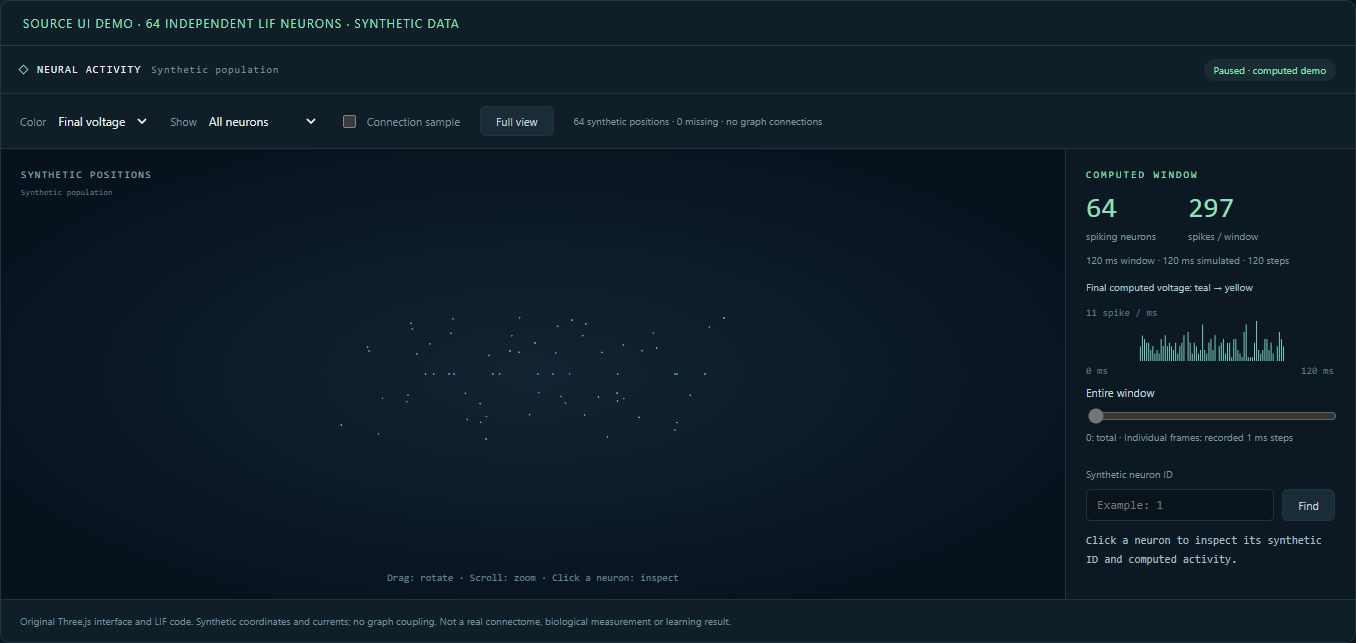
A Three.js interface visualizes events through a fly model and neural-activity view. Session code supports stepping, task selection, learning controls, checkpoints and continuation.
03 / ARCHITECTURE
How the pieces connect.
- LAYER 01
Data and graph layer
Annotations, neurotransmitter mappings and connection tables become a source-traceable graph archive and selected subgraphs.
- LAYER 02
Neural core and readout
Population simulation produces activity features; the output layer turns those features into a task action.
- LAYER 03
World adapter and evaluation
A task environment evaluates constrained programs and returns reward. Evaluation and checkpoint logic remain distinct from visual presentation.
04 / DATA & EXPERIMENTS
A traceable path from data to decisions.
The workflow distinguishes source data, modeling assumptions and observed task behavior.
- 01
Establish provenance
Select a dataset version and validate the source tables before processing.
- 02
Construct a subgraph
Map neuron identifiers, select connected populations and make weight/sign assumptions explicit.
- 03
Run a constrained task
Encode observations, compute LIF activity, select actions and evaluate the resulting short program.
- 04
Compare and challenge
Evaluate without training, compare controls and test whether previous behavior survives new learning.
Dataset provenance
The project documentation identifies MaleCNS v1.0 as the source for its real-connectome pipeline. Processing preserves source records and distinguishes neuron identifiers from graph indices.
Official MaleCNS project (opens in a new tab)What the experiments test
Current experiments examine activity-dependent decisions, constrained arithmetic tasks, readout variants and retention. Synthetic baselines and real-subgraph runs are separate conditions.
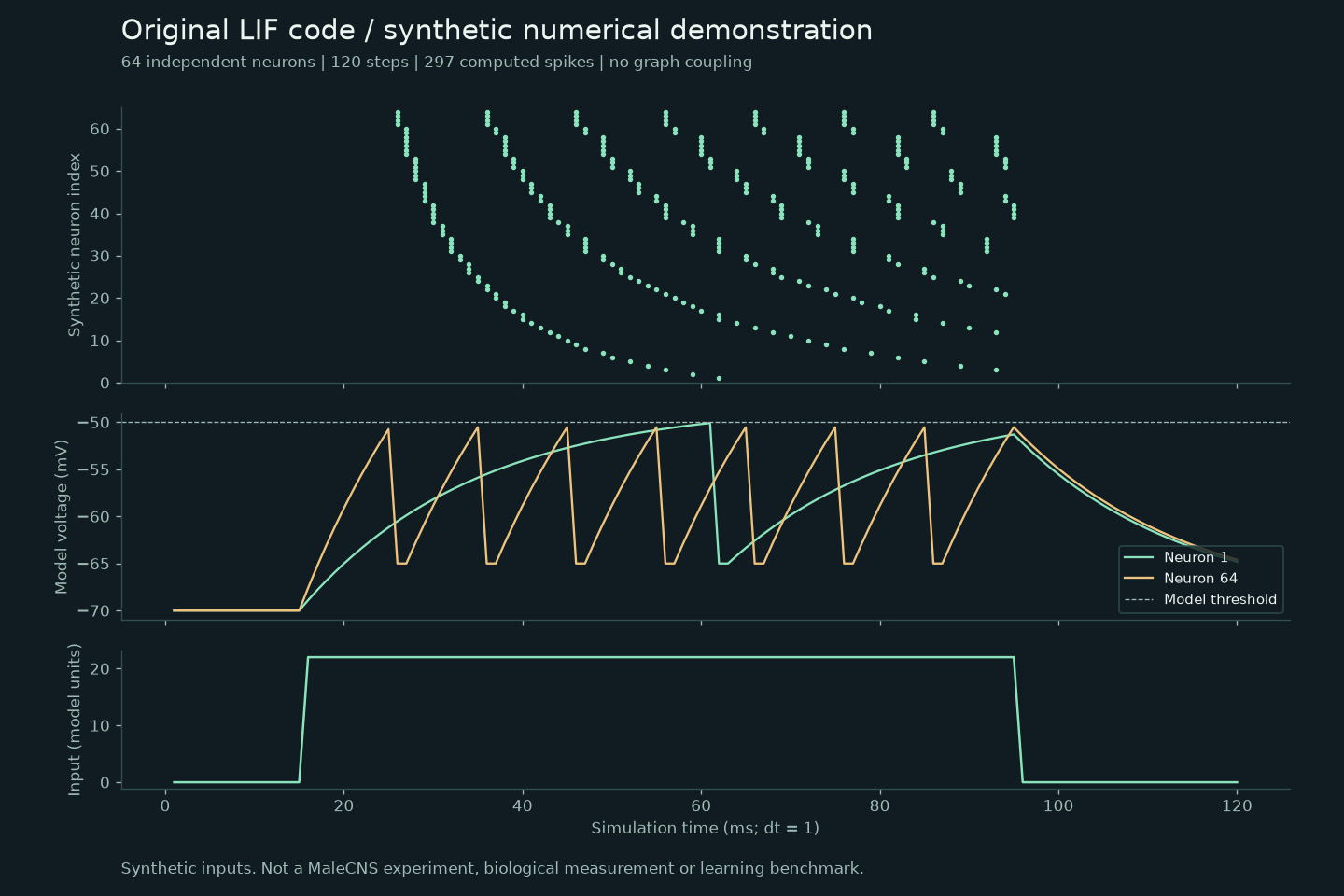
Pipeline diagrams describe the method. The numerical figure below uses synthetic inputs, with its computation and limitations stated explicitly.
SELECTED PROJECT EVIDENCE
Existing code, visible in context.
Captured from isolated copies of the actual project components. The demonstration conditions and limits travel with each image.
Computed behavior from the original LIF code
The existing neural activity interface
THE NEUROSCIENCE CONTEXT
A map of connections is a starting point.
What a connectome represents
A connectome describes identified neurons and their connections. A structural edge may summarize observed synaptic contacts. It does not specify every physiological parameter or determine the behavior of a living organism.
The dataset in this project
The inspected pipeline names MaleCNS v1.0, a Drosophila central nervous system connectome. Its code handles annotation, neurotransmitter and connectivity tables, download validation and conversion into simulation subgraphs.
Processing work and its evidence
Source code and dated documentation describe source receipts, neuron-ID mapping, filtering and weight/sign assumptions. The private processed archive was not re-audited here. This portfolio does not turn documentation into a claim of independently reproduced real-data results.
Why this is not a functioning brain
Leaky integrate-and-fire activity is a simplified computational model. A functioning brain also depends on physiology, sensory context, body dynamics and interactions omitted by this framework. A learned readout and a 3D fly visualization do not supply those missing mechanisms.
05 / DEVELOPMENT STATUS
What exists. What is established.
A feature can be implemented in code while its connected behavior still requires verification.
Data processing and model code
Source validation, neuron-ID mapping, graph construction and neural simulation paths exist. Private datasets and checkpoints were not opened for this portfolio.
Synthetic numerical demonstration
Selected figures exercise the original LIF code with synthetic inputs. These demonstrate code behavior, not a biological result or real-connectome benchmark.
Readout learning and retention
Constrained arithmetic, neural dependence and retention are research questions. Favorable diagnostic separation is not equivalent to program-generation competence.
Biological emulation and general coding
No functioning full fly brain, physiological fidelity, autonomous coding intelligence or validated research outcome is claimed.
06 / ENGINEERING CHALLENGES
The difficult parts are part of the work.
Provenance before computation
Dataset version, download receipts, node identity and filtering decisions need to survive the processing pipeline.
Structure is not physiology
Synapse counts require assumptions about effective weights, signs, time scales and input/output roles.
Isolate what was learned
Input encoding, a flexible readout and task scaffolding can improve a result even if the neural graph contributes little.
07 / METHODOLOGY
How the work is examined.
- 01
Keep synthetic controls separate from real-connectome conditions.
- 02
Evaluate held-out inputs without learning and compare signal, graph and readout interventions.
- 03
Record failed conditions and retention checks alongside any favorable result.
08 / NEXT DEVELOPMENT STEPS
A roadmap with verification gates.
Proposed next steps based on the source review; no completion dates or release commitments are inferred.
- 01NEXT STEP
Reproducible experiment records
Publish only authorized, reproducible figures with dataset provenance and explicit model assumptions.
- 02NEXT STEP
Stronger controls
Compare neural dependence, non-learning baselines and held-out task behavior.
- 03NEXT STEP
Retention before broader claims
Test whether learning a new constrained task preserves earlier behavior before extending the task vocabulary.
09 / SCOPE & LIMITATIONS
A clear boundary around the claims.
An experimental model, with controls.
The research framework can implement an experiment without demonstrating its hypothesis. Those are different milestones.
- A connectivity graph and LIF activity are not a physiological emulation of an entire functioning fly brain.
- Reliable general arithmetic learning and general Python-programming ability have not been demonstrated. Available commands are not proof of learned competence.
- The 3D fly is an event visualization, not a biomechanical body or flight simulation. Computed activity is not recorded biological activity.
- Synthetic baselines and real-connectome subgraph experiments must be distinguished. Numerical results were not independently reproduced during this website review.
10 / RESEARCH IN PROGRESS
Questions that guide the next step.
What contributes to the decision?
Separate the effect of changing neural signals from input encoding, output-layer capacity and task-specific scaffolding.
What is learned and retained?
Measure performance on held-out inputs, compare controls and test whether gains transfer without erasing previous behavior.